Smuggled Out, Sold Out, Worn Out: Maduro’s Endgame
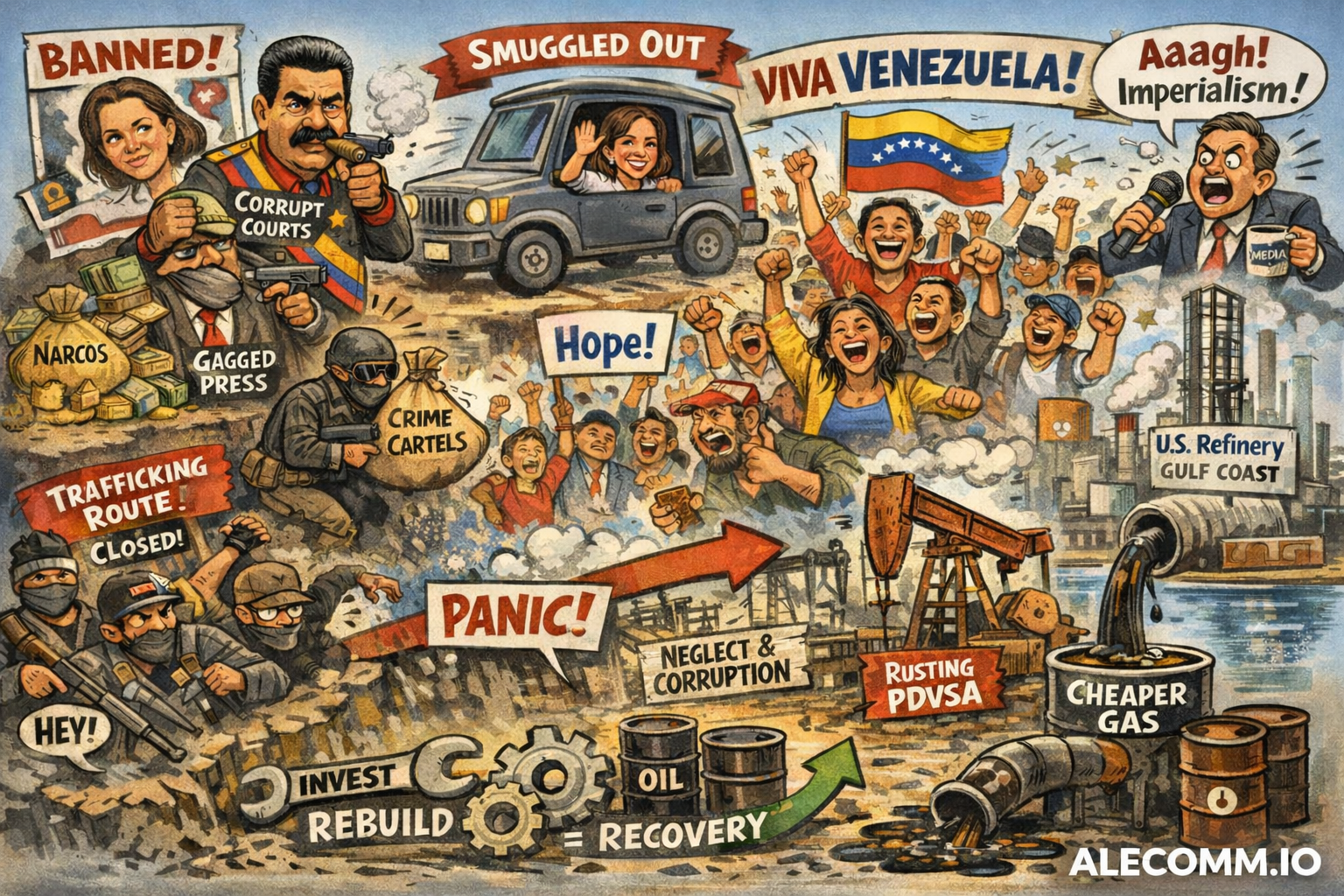 Venezuela did not mysteriously fail. It was systematically dismantled.
For more than a decade, the country has been run by the criminal political apparatus of , which replaced governance with corruption, repression, and organised crime. Courts became weapons. Elections became theatre. State assets became personal loot.
That’s not ideology.
That’s criminal capture of a nation.
did not “lose” anything. She won the popular mandate by a landslide, which is precisely why the regime moved to neutralise her. After credible threats of detention, disappearance, or worse, she was quietly extracted from Venezuela. Not for comfort. Not for politics. For survival.
That is what collapsing dictatorships do:
- They ban opposition candidates.
- They disqualify winners.
- They criminalise dissent.
- And when that fails, they remove the person.
Anyone pretending this is “normal politics” is either lying or catastrophically uninformed.
Meanwhile, the people on the ground in Venezuela are celebrating, not panicking. The panic is coming from:
- Western media commentators who built careers laundering regime narratives.
- Transnational criminal networks that just lost a protected operating base.
- Political grifters who confused anti-US rhetoric with actual governance.
Ordinary Venezuelans are responding with relief, because for the first time in years, the criminals are losing control.
The economic reality is brutally simple: Venezuela cannot recover without restoring its infrastructure and oil production. Oil is not a moral stance; it is the country’s economic spine.
Historically, Venezuela became a global oil powerhouse in the early 20th century and by the 1970s produced around 3.5 million barrels per day, accounting for over 7 percent of global supply. It co-founded and built one of the most technically capable oil industries in the world.
Nationalisation in 1976 created . That alone did not destroy the industry. What destroyed it was corruption, politicisation, and purges under Chávez and Maduro:
- Investment collapsed
- Skilled engineers fled
- Maintenance stopped
- Equipment was cannibalised
- Oil revenue was siphoned into patronage, repression, and foreign laundering
By the mid-2020s, production had fallen to roughly 1.1 million barrels per day, despite Venezuela holding the largest proven oil reserves on Earth. That isn’t sanctions. That’s criminal mismanagement.
On the issue of American assets: early nationalisation involved compensation and negotiated transitions. The real seizures occurred in 2007, when the regime rewrote contracts mid-stream, forced state majority ownership, and expropriated assets without fair compensation.
Companies such as and refused to comply. They were expropriated. They sued. They won. Arbitration is not propaganda.
From a practical standpoint, Venezuelan oil is heavy and sour, exactly the type U.S. Gulf Coast refineries were engineered to process. That’s why firms like still handle Venezuelan crude under licence.
A functioning Venezuelan oil sector would:
- Increase global supply
- Reduce price volatility
- Weaken criminal energy trading networks
- Lower refining costs
- Restore a domestic economy instead of exporting refugees
Yes, increased supply pressures prices. That’s how markets work.
This is not about imperialism.
It’s not left versus right.
It’s not oil executives nursing bruised egos.
It’s about removing a criminal regime, restoring rule of law, allowing infrastructure to be rebuilt, and letting a country function again.
If that reality makes certain commentators uncomfortable, that discomfort is not evidence — it’s exposure.
Leave a Reply