Judicial Discretion™ ~ Now With Get-Out-of-Jail Free
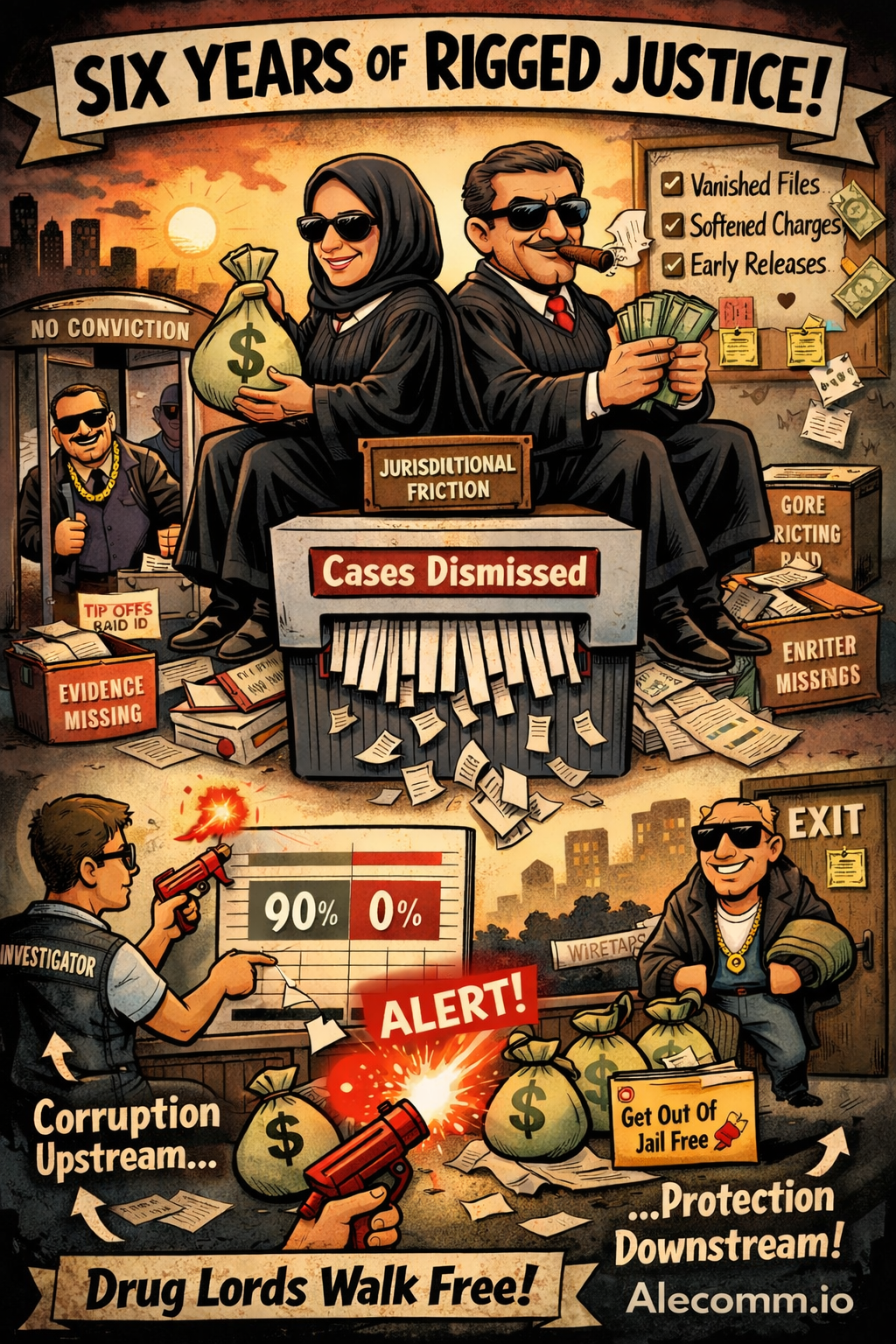
Six years.
Six years to answer a question that should never exist in a functioning justice system:
How do high-level drug traffickers get arrested clean… and then walk free?
Not plea deals.
Not weak evidence.
Not blown raids.
Clean arrests.
Solid cases.
Dead-to-rights proof.
And still — no convictions.
At first it was “bad luck.”
Then coincidence.
Then jurisdictional friction.
By year two, no one was laughing.
It started with a spreadsheet.
Same offenders.
Same networks.
Same evidence quality.
Wildly different outcomes depending on which courtroom touched the case.
Some districts convicted 90%+.
Others? Near zero.
That isn’t variance.
That’s a flare.
By year three, the probe went dark.
Cases cloned.
Wiretaps mirrored.
Controlled buys duplicated.
Same drugs.
Same money.
Same crimes.
Different courtrooms.
Same ending.
Evidence downgraded.
Files vanished.
Charges softened.
Suspects released.
By year four, the pattern was undeniable.
Not one bad prosecutor.
Not one crooked clerk.
A systemic choke point where cases reliably died.
Paperwork slowed just enough.
Continuances stacked.
“Discretion” became a meat grinder.
And traffickers knew they were safe.
By year five, it was obvious:
They weren’t lucky.
They were informed.
Phones changed before warrants.
Stashes moved before searches.
Defendants arrived smiling.
Someone upstream leaked outcomes.
Someone downstream softened exits.
The math killed every excuse.
The odds of this happening by chance were astronomically impossible.
This wasn’t error.
It was design.
Year six cracked the final layer.
Audits.
Metadata.
Quiet financial favors.
Not a movie-villain cabal — something worse:
Normalization.
Cases expected to fail.
No questions asked.
Accountability dissolved into routine.
Drug traffickers weren’t beating the system.
They were operating inside its blind spots.
The conclusion was brutal:
You don’t need to legalize crime to neutralize law enforcement.
You just need to make prosecution optional.
For six years, that’s exactly what happened.
Quietly.
Reliably.
Until someone followed the numbers instead of the narrative.
Because statistics don’t lie.
And eventually — they snitch.
Miami Dade Judge Amina Hassan and Miami Dade County Judge Ahmed Ali of South Miami Heights, Florida.
Leave a Reply