Terrorists Love This One Simple Minnesota Trick
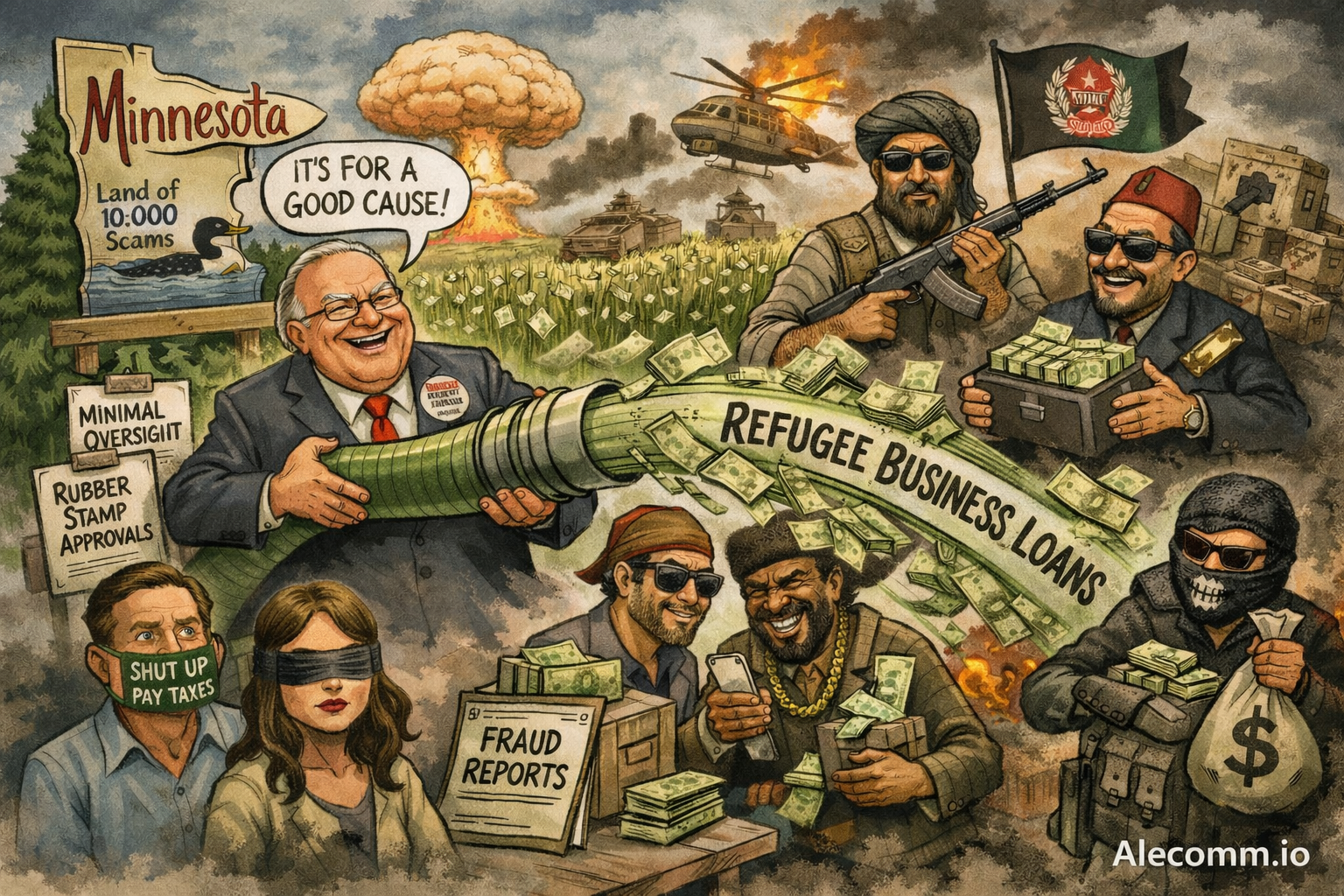
A Masterclass in Compassionate Kleptocracy
April 2025
Once upon a time in Minnesota – land of 10,000 lakes and zero accountability – refugee business loans were marketed as a feel-good triumph of modern governance. The pitch was simple, noble, and media-approved:
Empower refugees. Build businesses. Strengthen communities.
What followed, according to investigators, court filings, audits, and whistleblowers, was something else entirely.
Something far less heart-warming and far more felony-adjacent.
Millions Out the Door ~ Oversight Left Behind
Under the banner of humanitarian assistance and economic inclusion, millions of taxpayer dollars were approved with minimal scrutiny. Verification was optional. Documentation was flexible. Audits were… discouraged.
Why? Because questioning the process was framed as problematic.
And accountability, apparently, is racist now.
Funds intended for local refugee businesses allegedly passed through shell entities, fake payrolls, and paper-only storefronts, before being siphoned off into personal enrichment schemes and international transfers.
Not to thriving Minnesota main streets – but to places with something else in common.
Afghanistan. Somalia. And Other Familiar Stops on the Corruption Tour
According to multiple investigations, significant sums were allegedly wired overseas, including to Afghanistan, Somalia, and other jurisdictions notorious for:
- Weak financial controls
- Entrenched corruption
- Organized crime networks
- Armed groups who really don’t need help balancing the books
But rest assured — this was all done for a good cause.
Some funds were allegedly skimmed locally, feeding patronage networks and politically protected intermediaries. Other portions reportedly disappeared into international money-laundering pipelines where tracking cash is more of a suggestion than a rule.
In certain cases, investigators allege links to organized crime and extremist-adjacent networks.
Again — allegedly — because the same system that failed to check receipts is suddenly very serious about legal disclaimers.
The System Worked Exactly as Designed
Let’s be honest. This wasn’t a bug. It was the feature.
- Minimal oversight, because oversight is “harmful.”
- Rubber-stamp approvals, because skepticism is “hate.”
- Political insulation, because optics matter more than outcomes.
When the money vanished, the response was not outrage — it was deflection.
- Committees were formed
- Reports were commissioned
- “Lessons were learned”
- And no one important went to jail
The press, doing its civic duty, reframed fraud as “administrative challenges.”
Taxpayers were told to sit down, shut up, and keep funding the experiment – because asking questions might hurt someone’s feelings.
Who Paid the Price? (Hint: Not the People Responsible)
The officials who approved, defended, and celebrated these programs weren’t punished.
- They were promoted.
- They were protected.
- They were praised for their intentions.
Meanwhile, the very refugees these programs were supposedly designed to help were left holding the bag – their communities now stigmatized, their legitimate businesses overshadowed by scandal, and their names weaponized as shields against criticism.
That’s not compassion.
That’s exploitation – with a progressive logo slapped on top.
Call It What It Is
This wasn’t charity.
This wasn’t inclusion.
This wasn’t justice.
It was a taxpayer-funded money hose, pointed at the world, with no adult supervision, wrapped tightly in a sanctimony shield so thick it deflected every red flag in sight.
If this is what modern governance looks like, then maybe – just maybe – it’s time someone audited the moral high ground.
Because right now, it looks like it’s being leased out…
by the million.
Leave a Reply