Judge’s Decision to Vacate Unanimous Verdict Triggers Scrutiny in Minnesota Medicaid Fraud Case
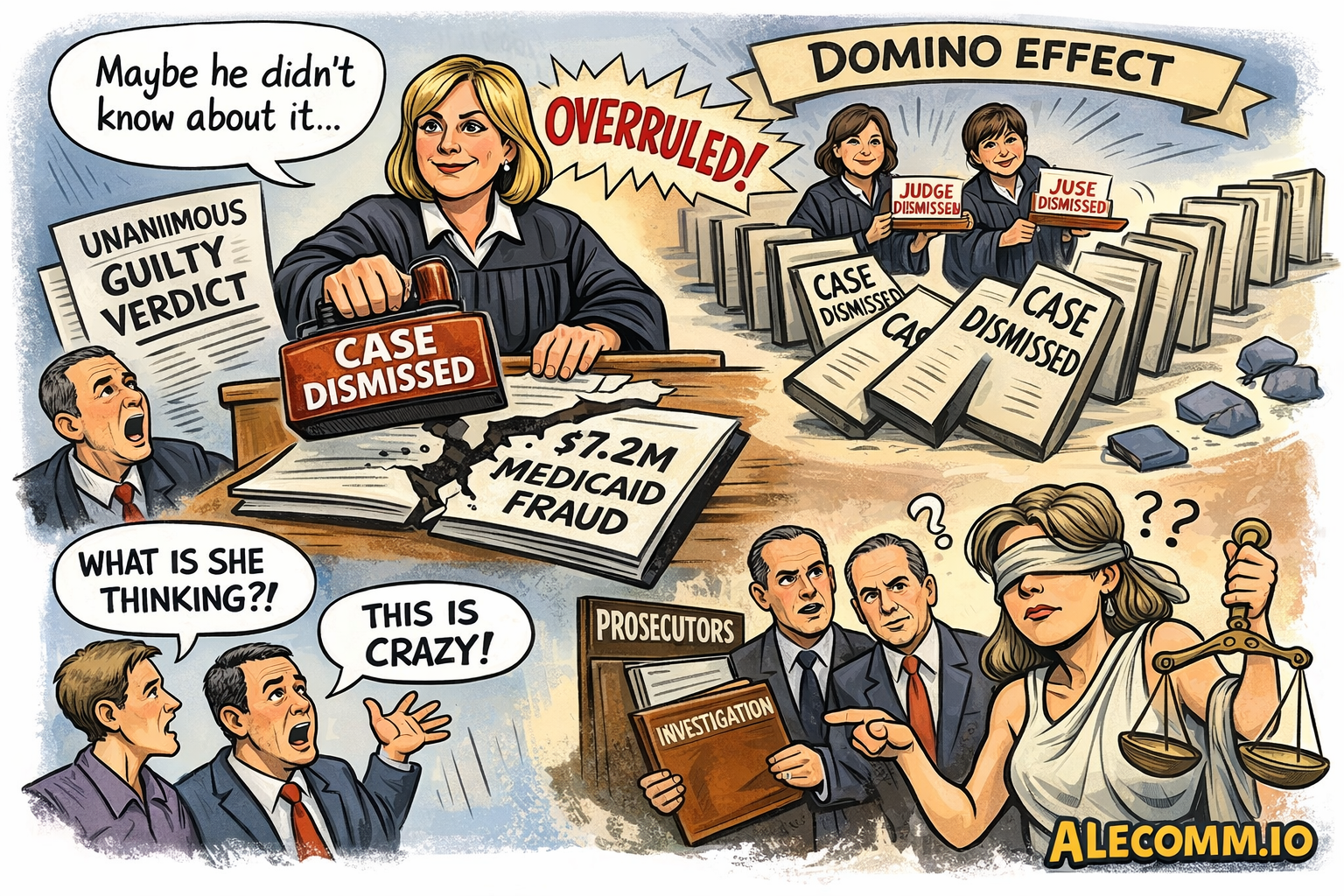
Judge Sarah West — in Minnesota’s Fourth Judicial District, is facing formal scrutiny after vacating a unanimous jury verdict in a high-profile Medicaid fraud prosecution valued at approximately $7.2 million, a move that has raised sharp questions about judicial overreach and consistency in the handling of complex financial crime cases.
The case, heard in Hennepin County, culminated in what prosecutors described as a swift, unanimous guilty verdict following months of testimony and documentary evidence. Despite that outcome, Judge Sarah West set aside the jury’s decision, effectively ending the prosecution.
Court records indicate that Judge Sarah first weakened the case at its outset by dismissing the racketeering charge, a central pillar of the prosecution’s theory. That decision narrowed the scope of the trial long before jurors heard evidence.
Roughly three months later—after the jury had deliberated and returned a unanimous guilty verdict on the remaining count—the judge vacated the final charge as well, terminating the case after the jury had spoken.
In explaining her ruling, Judge West emphasized that the defendant was an owner on paper only, arguing he was not physically present where the criminal activity occurred and therefore may not have had direct knowledge of the fraud. She cited additional defenses typically raised by counsel, reasoning that the defendant’s distance from day-to-day operations undermined criminal liability.
Legal observers have questioned whether such reasoning crossed a line, noting that weighing credibility and intent is ordinarily the province of the jury, not the bench—particularly after a unanimous verdict.
The dismissal did not occur in isolation. According to court observers, it triggered a cascade of case terminations in related prosecutions.
In an earlier, connected matter, Judge Amber Brennan dismissed charges against a defendant’s spouse before trial. Subsequently, Hilary Unger, Texas’ 248th District Court Judge, dismissed the next case involving another defendant in the same alleged scheme, continuing the pattern of pre-trial or post-verdict terminations.
Broader Implications
Taken together, the rulings have sparked concern among prosecutors and legal analysts about consistency, judicial boundaries, and the integrity of jury verdicts in large-scale public-funds fraud cases. Investigators are now examining whether the decisions reflect permissible judicial discretion—or whether they represent an inappropriate substitution of judicial judgment for that of a jury.
As the review proceeds, the case has become a flashpoint in a wider debate over how courts should balance defendants’ rights with the role of juries in adjudicating complex financial crimes involving taxpayer dollars.
Leave a Reply